How AI Overviews Change Legal Search Behavior Today

For decades, the journey of finding a local attorney followed a highly predictable script. A prospective client facing a legal issue would open Google, type a fragmented query like “personal injury lawyer near me” or “best divorce attorney Austin,” and scroll through the familiar Local Map Pack or the first few blue links. Law firms spent significant time, money, and resources optimizing for this exact behavior.
Today, that landscape is undergoing a massive transformation. The introduction of generative AI into search engines is fundamentally altering the way users seek, consume, and act on legal information. If you are a law firm owner, a legal marketer, or an SEO professional, understanding exactly how ai overviews change legal local search behavior is no longer just a futuristic concept—it is a present-day necessity.
In this comprehensive guide, we will explore the nuances of this transformation. We will break down the mechanics of the new search experience, analyze the shifting intent of potential clients, and provide actionable strategies to ensure your law firm remains visible, authoritative, and highly competitive in an AI-driven digital world.
The Dawn of Generative Search in the Legal Sector
To grasp the magnitude of this shift, we first need to look at what Google’s AI Overviews—formerly known as the Search Generative Experience (SGE)—actually do.
When a user types a query into Google today, they are increasingly met with an AI-generated snapshot at the very top of the search results page. This overview synthesizes information from multiple sources across the web to provide a direct, comprehensive answer. Instead of forcing the user to click through three different law firm blogs to understand the statute of limitations for a slip-and-fall case, the AI compiles the answer right there on the search page. This shift clearly shows how ai overviews change legal local search behavior by surfacing decisive guidance before a user ever clicks through.
AI Overviews vs Traditional Local Pack Rankings
In the past, local SEO for lawyers was largely an ongoing battle for the “Local Pack”—the top three map listings displayed for geo-modified searches. While the Local Pack remains incredibly important, the dynamic of AI overviews vs traditional local pack rankings is creating a new hierarchy.
AI snapshots now frequently appear above or alongside the traditional map pack. Furthermore, these overviews do not merely list businesses; they contextualize them. For instance, if a user asks, “Who is the best estate planning lawyer in Denver for small business owners?”, the AI doesn’t just trigger a proximity-based map. It attempts to read reviews, analyze website content, and synthesize a narrative about why certain Denver lawyers might be the best fit for small business owners. This requires a much deeper level of content optimization than simply stuffing localized keywords into a Google Business Profile.
Decoding the Shift in Legal Consumer Search Behavior
The way people formulate their questions is changing. Because AI models are conversational, they invite users to speak to them as they would to an actual human attorney. This has sparked a massive shift in legal consumer search behavior.
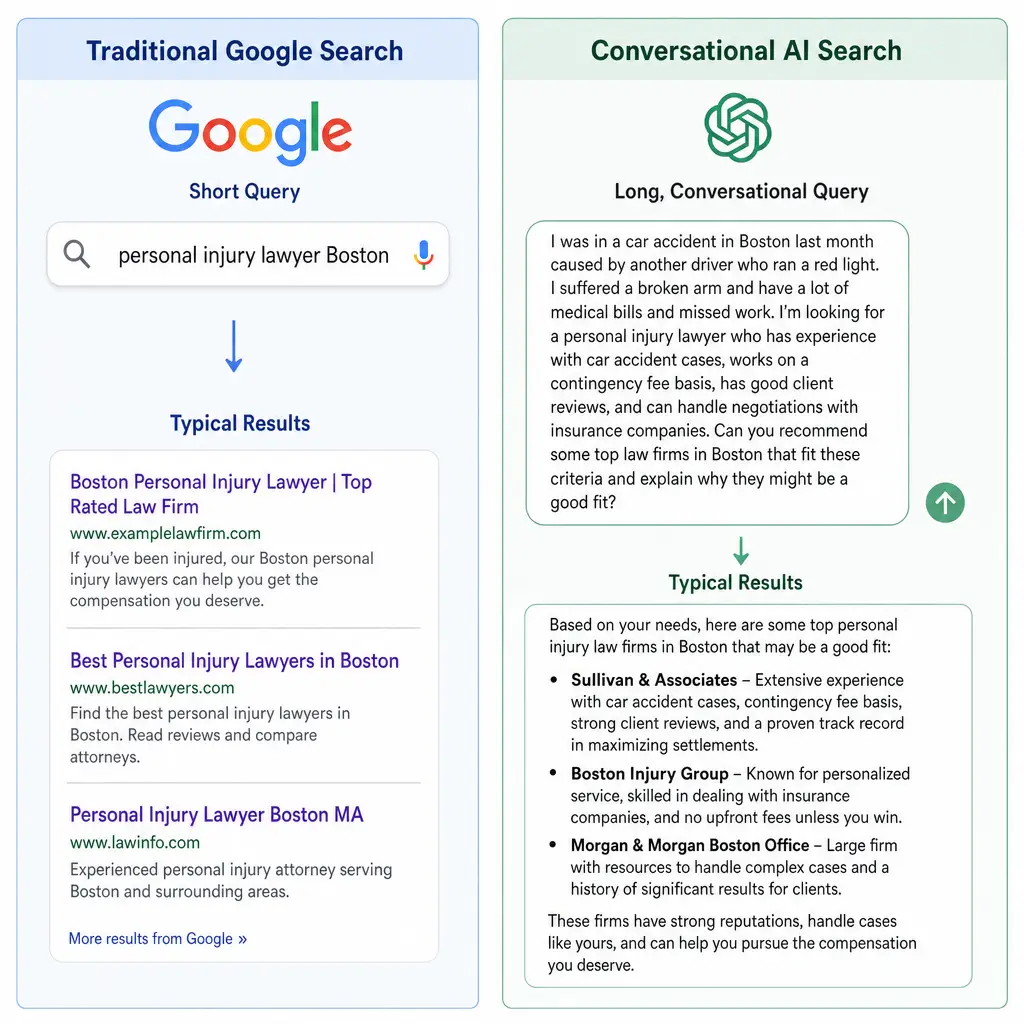
Historically, searchers used “caveman queries”—short, keyword-dense phrases. Now, we are witnessing a profound user intent shift in legal search. People are leaning into complex, multi-part questions.
Instead of searching for “DUI lawyer Miami,” a user is now much more likely to type or voice-search: “I got pulled over for a DUI in Miami but I refused the breathalyzer, what are the immediate penalties and which local lawyer offers free consultations?”
This evolution emphasizes natural language legal queries for local firms. AI algorithms excel at parsing these long-tail, highly specific scenarios. Consequently, law firms that only optimize for broad, head terms will find themselves losing visibility to competitors who answer these nuanced, conversational questions thoroughly on their websites.
AI Legal Search Behavior and the Demand for Immediacy
This new ai legal search behavior is driven by a demand for immediate clarity. Facing a legal crisis is inherently stressful. When prospective clients turn to search engines, they are looking for reassurance and immediate answers.
The integration of ai in law extends beyond just how lawyers write contracts or perform document review; it is changing how legal consumers educate themselves. In this era, users rely on AI to perform initial triage on their legal issues. They use legal research ai tools integrated into search engines to figure out if they even have a viable case before they ever pick up the phone to call a firm.
The Zero-Click Search Conundrum
One of the most pressing concerns for legal marketers right now is the rise of the “zero-click search.” A zero-click search occurs when a user gets the answer they need directly from the AI overview and leaves the search engine without ever clicking on a link to a law firm’s website.
When answering informational queries (e.g., “What is the difference between a Chapter 7 and Chapter 13 bankruptcy in Ohio?”), AI overviews often provide such thorough summaries that the user feels no need to click through to read your carefully crafted 1,500-word blog post.
So, what is the impact of SGE on law firm local SEO if traffic to informational pages drops?
The reality is that optimizing law firm websites for zero-click searches requires a mindset shift. Instead of solely chasing website traffic, firms must focus on brand visibility within the AI snapshot itself. Even if a user doesn’t click your link, seeing your law firm cited as the source of the AI’s answer builds immense trust. When they move from the research phase to the hiring phase, your firm’s name will already carry authority.
Navigating the Attorney-Client Conversion Journey in AI
With search traffic patterns shifting, you might be wondering: exactly how do users find attorneys in AI snapshots?
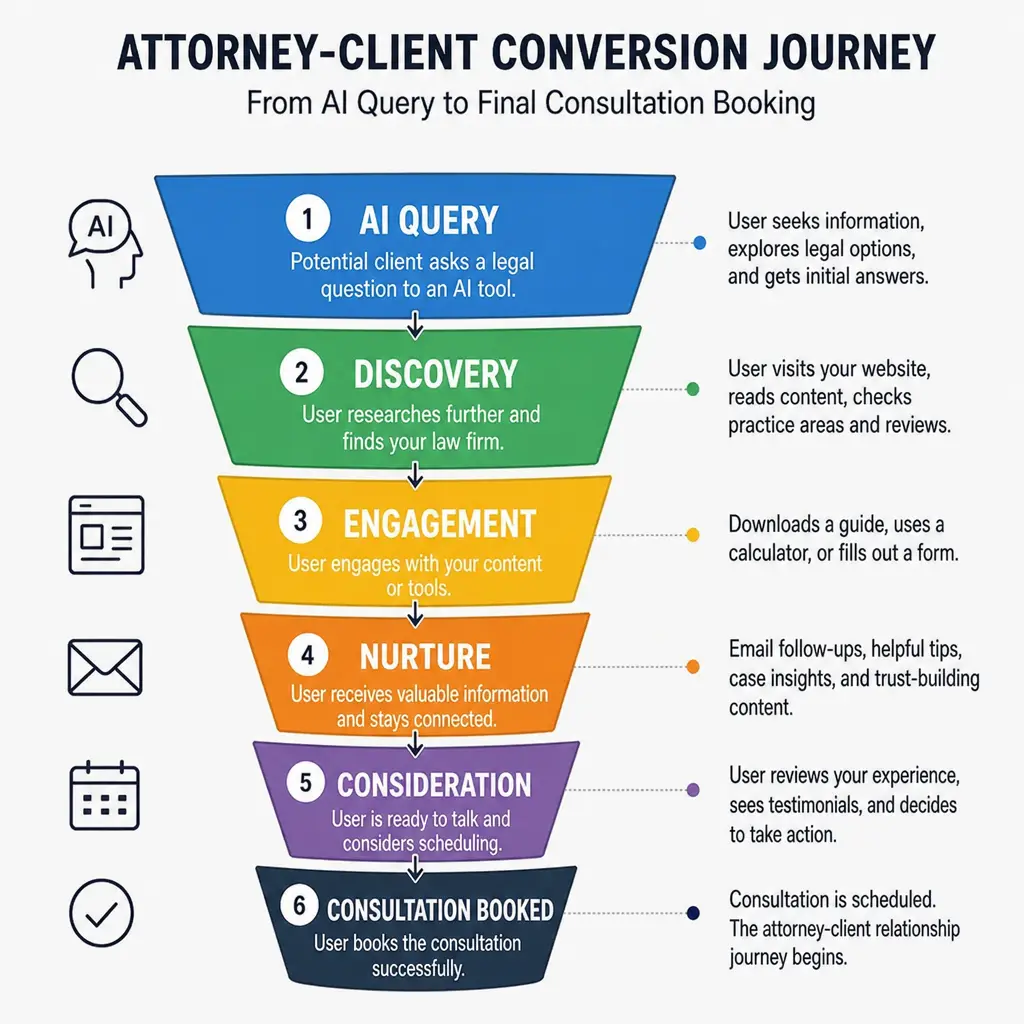
The Google Search Generative Experience legal discovery process is highly nuanced. It generally follows a modified funnel:
- The Trigger Event: The user experiences a legal issue (e.g., a car accident).
- The Conversational Query: The user asks a highly specific, localized question to an AI search engine.
- The AI Snapshot Processing: The AI aggregates local data, reviews, and authoritative content to generate a response.
- The Citation Click (or Triage): The user reads the summary. If they need a lawyer, they click on the embedded citation links within the AI overview—which often feature law firms that provided the most accurate, concise information.
- The Conversion: The user visits the firm’s site, pre-educated by the AI, and reaches out for a consultation.
This new attorney-client conversion journey in AI means that your content must serve two masters: it must be readable and persuasive for the human prospect, while also being structured, factual, and easily extractable for the AI bot.
Actionable Strategies to Future-Proof Your Law Firm’s SEO
Understanding how ai overviews change legal local search behavior is only the first step. The critical question is how to adapt your marketing strategy to ensure you remain competitive. Here are the most effective strategies for increasing lawyer visibility in Google generative experience.
1. Fortify Your E-E-A-T Signals
Google’s AI is incredibly cautious when generating answers for “Your Money or Your Life” (YMYL) topics, which heavily includes the legal sector. To prevent giving harmful legal advice, the AI relies strictly on high-authority sources.
Therefore, establishing strong E-E-A-T signals for legal AI snapshots (Experience, Expertise, Authoritativeness, and Trustworthiness) is non-negotiable.
- Experience & Expertise: Ensure every blog post or practice area page has a clear, visible author bio linking to the attorney’s credentials, bar association memberships, and past case results.
- Authoritativeness: Earn backlinks from reputable legal directories, local news sites, and educational institutions. AI models use these to determine if you are among the authoritative legal sources for AI summaries.
- Trustworthiness: Keep all legal information up to date. If an AI detects conflicting information regarding a state law on your site versus a government site, it will ignore your site.
2. Implement a Hyper-Specific, Geo-Targeted Content Strategy
Because natural language queries often contain hyper-local qualifiers, broad content is no longer enough. You must deploy a robust geo-targeted legal content strategy.
Instead of writing a generic page on “Car Accident Lawyer,” create content that addresses specific local intersections, local county court procedures, or regional insurance quirks.
- Example: Write an article detailing “How Personal Injury Claims Work in the Cook County Court System” or “What to Do After a Collision on Interstate 35 in Austin.” When local users ask AI conversational questions about their specific geographic situation, the AI will pull from websites that have documented that exact localized data.
3. Master Citation Management for Generative Search
In the old days of local SEO, citations (your Name, Address, and Phone number across various directories) were about consistency to rank in the Map Pack. Today, citation management for generative search goes much deeper.
AI models scour the web to verify facts. If your Avvo profile says you specialize in family law, but your Google Business Profile highlights criminal defense, the AI becomes confused and will likely omit your firm from its generated answers. Ensure that your firm’s narrative, practice areas, and attorney credentials are comprehensively detailed and perfectly consistent across Yelp, Justia, FindLaw, local Chambers of Commerce, and your own website.
4. Cultivate Local Law Firm Brand Mentions
AI doesn’t just look at links; it looks at entities and mentions. If your law firm is frequently discussed in positive contexts across the web—even without a hyperlink—the AI recognizes your firm as a prominent local entity.
Encourage local law firm brand mentions by participating in community events, sponsoring local charities, hosting free legal clinics, or providing expert commentary to local news outlets. When a user asks an AI, “Who are the most community-involved personal injury lawyers in Seattle?”, the AI will aggregate these brand mentions to generate its recommendation.
5. Format Content for AI Extraction (The “Bite-Sized” Approach)
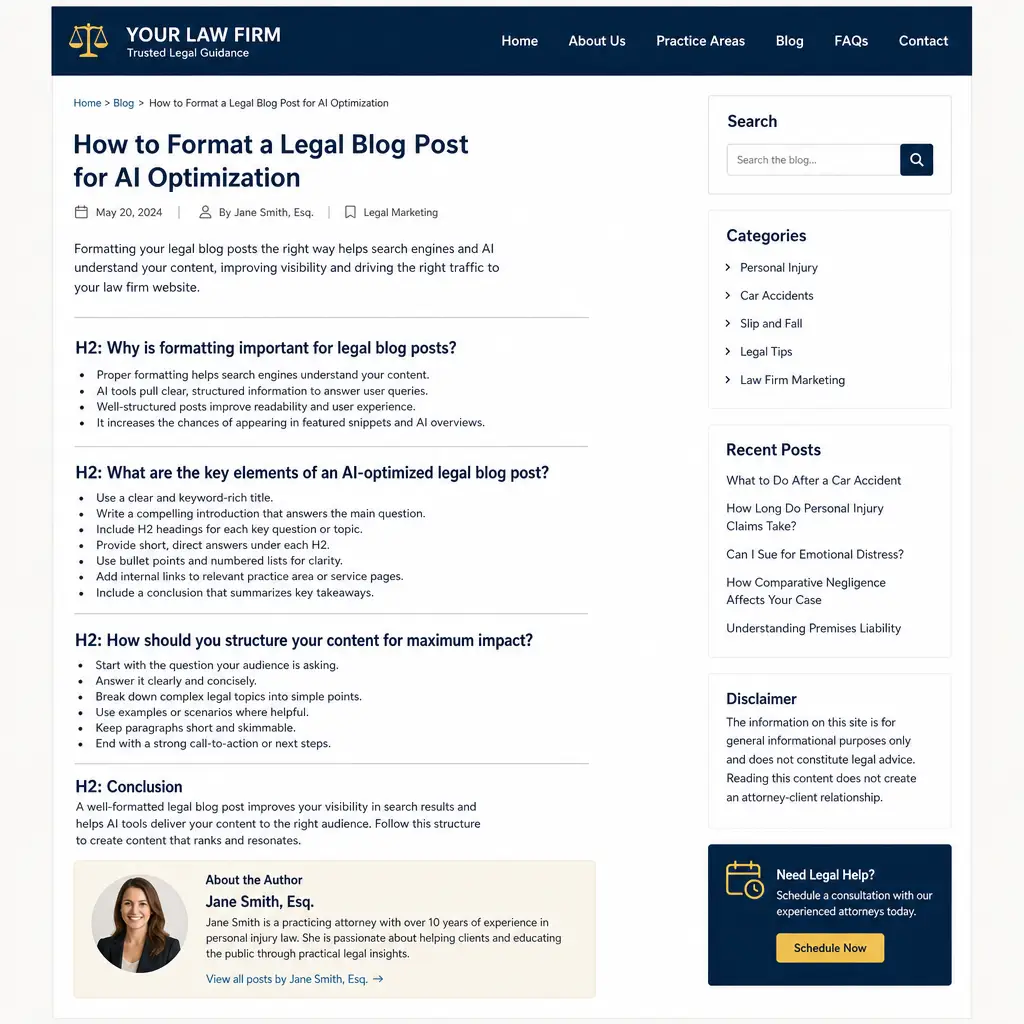
AI overviews love structure. They synthesize information by looking for clear, definitive answers. To optimize for this, use strategic formatting:
- Inverted Pyramid Writing: Answer the core question directly in the first sentence of the paragraph, then provide the detailed legal context below it.
- Use robust Headings (H2s and H3s): Frame your headings exactly as the user would ask the question (e.g., H2: What is the Statute of Limitations for Medical Malpractice in Florida?).
- Lists and Tables: AI frequently pulls bulleted lists and tables into its snapshots. If you are comparing two types of divorce processes, put the comparison into a clean HTML table.
The Future of Legal Local Search
As search engine algorithms continue to learn and evolve, and as ai in law and legal research ai become ubiquitous, the line between traditional search and AI assistance will blur completely. Law firms can no longer rely on the outdated playbook of keyword stuffing and generic practice area pages.
The firms that will dominate their local markets in the coming years are those that recognize this paradigm shift. By embracing natural language queries, establishing undeniable authority, and structuring website data so that AI bots can effortlessly digest it, forward-thinking attorneys will capture a massive competitive edge.
Ultimately, understanding exactly how ai overviews change legal local search behavior gives you the blueprint to adapt. The medium through which people find you is changing, but the core need remains the same: individuals in distress are looking for a trustworthy, expert advocate. By aligning your digital presence with the mechanics of generative AI, you ensure that when potential clients ask for help, it is your firm that provides the answer.
Q&A
AI Overviews are AI-generated snapshots that appear at the top of search results, synthesizing information from multiple sources to deliver direct, contextual answers. Unlike the traditional Local Pack—which primarily lists nearby firms—AI Overviews often appear above or alongside it and explain why certain firms fit a query. They analyze reviews and website content to build a narrative (e.g., best fit for small business owners), so visibility now depends on being a trustworthy, well-cited source rather than just proximity and basic local signals.
Users are moving from short, keyword-heavy “caveman queries” to natural, conversational, and hyper-specific questions (often with local nuances). They expect immediate clarity and use AI as a first-pass triage tool to assess their situation before contacting a lawyer. As a result, firms that only optimize for broad head terms risk losing visibility to competitors who address long-tail, scenario-based, and locally detailed questions thoroughly on their sites.
Zero-click searches occur when users get complete answers from the AI overview and don’t click through to any site—especially on informational queries. Instead of chasing only traffic, firms should optimize for inclusion and citation within the AI snapshot itself. Being cited builds brand authority and trust during the research phase, increasing the likelihood that prospects will choose your firm when they move to the hiring stage, even if they didn’t click your informational page initially.
The journey typically flows through: a triggering legal event, a highly specific conversational query, AI snapshot processing that aggregates local data and authoritative content, a citation click (or user triage within the snapshot), and finally conversion on a firm’s site. To win in this funnel, content must serve both humans and AI: it should be clear, factual, structured, and easily extractable while also persuasive and empathetic for the prospective client.
-Fortify E‑E‑A‑T: Use clear attorney bios with credentials and bar memberships; earn authoritative backlinks; keep legal information accurate and current (crucial for YMYL topics).
-Create hyper‑specific, geo‑targeted content: Address local courts, intersections, and regional nuances so AI can match your pages to localized, conversational queries.
-Master citation management: Ensure consistent practice areas, credentials, and NAP details across Google Business Profile, Avvo, Justia, FindLaw, chambers, and your site to avoid AI confusion.
-Cultivate local brand mentions: Engage in community events, media commentary, and clinics so AI recognizes your firm as a prominent local entity—even without links.
-Format for AI extraction: Lead with direct answers (inverted pyramid), use question-based H2/H3s, and include lists/tables to make key facts easy for AI to pull into snapshots.
They can reduce clicks for early-stage informational searches, but they may also improve lead quality by sending more “pre-educated” prospects to your site. The best defense is to make sure your firm is visible in the snapshot (citations/mentions), and that your site clearly answers “next step” questions like consultations, fees, timing, and what to bring.
Pages that are specific, factual, and well-structured tend to perform best—think practice-area explainers, local process guides (county/court specifics), clear FAQ pages, and attorney-authored articles with citations, dates, and plain-language definitions.
Keep your practice areas, services, categories, hours, photos, and Q&A accurate and consistent with your website and major directories. AI systems cross-check these sources; mismatches can reduce trust and make it harder for your firm to be included in AI-generated local recommendations.